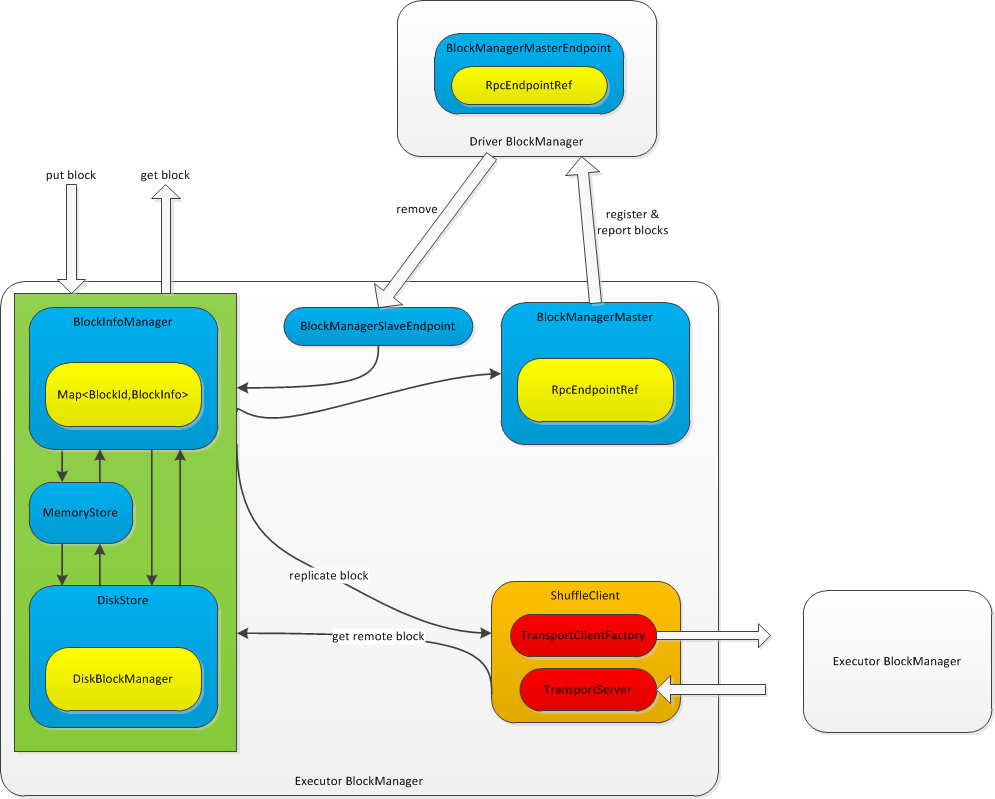
作为分布式应用,Spark的数据存储在不同机器上。这就涉及到数据的传输,元数据的管理等内容。而且由于Spark可以利用内存和磁盘作为存储介质,这还涉及到了内存和磁盘的数据管理。
1. Spark存储体系架构
Spark 存储(主要由BlockManager 来完成)主要完成了写入数据块,如果需要备份数据块,则将数据块写入其他节点;读取数据块,如果当前节点不含有数据块,则从其他节点获取数据块;向Driver 节点注册自身的BlockManager ,以及上报其所管理的数据块信息。
Spark 使用BlockInfoManager 来管理当前节点所管理的数据块的元数据,维护了BlockId (数据块的唯一标识)到BlockInfo (数据块元数据)的映射关系。使用内存(MemoryStore )和磁盘(DiskStore )来存储数据块。
Spark 使用BlockManagerMaster 使Executor 的BlockManager 与Driver 进行通信,向Driver 注册自己,并上报数据块信息。Driver 通过Executor BlockManager 的BlockManagerSlaveEndpoint 向Executor 发出删除数据块**/Rdd/Shuffle/Broadcast**等数据。
Spark 使用ShuffleClient 来实现不同Executor BlockManager 之间的通信。ShuffleClient 中包含了一个TransportServer 和一个用来创建client的TransportClientFactory ,作为服务器和客户端实现Executor BlockManager 之间的双向通信。
Spark设置了多种存储级别:
存储级别
说明
DISK_ONLY
只使用磁盘存储
DISK_ONLY_2
只使用磁盘存储,并且有一个备份
MEMORY_ONLY
只使用内存储存储
MEMORY_ONLY_2
只使用内存存储,并有一个备份
MEMORY_ONLY_SER
只使用内存存储序列化数据
MEMORY_ONLY_SER_2
只使用内存存储序列化数据,并有一个备份
MEMORY_AND_DISK
优先内存存储,内存不足则使用磁盘
MEMORY_AND_DISK_2
优先内存存储,内存不足使用磁盘,并有一个备份
MEMORY_AND_DISK_SER
优先内存存储序列化数据,内存不足使用磁盘
MEMORY_AND_DISK_SER_2
优先内存存储序列化数据,内存不足使用磁盘,并有一个备份
OFF_HEAP
使用堆外存储(同MEMORY_AND_DISK_SER,只是使用堆外内存)
put block (写入数据块 ):在写数据块的时候,根据存储级别的不同,
如果存储级别 要求存储序列化/非序列化 的数据,而输入的数据块是非序列化/序列化的,则要首先序列化/反序列化;
如果支持内存存储,则将数据块保存到内存中;
如果设置了MEMORY_AND_DISK 之类的存储级别,当内存不足时,会将数据块写入磁盘。
如果不支持内存存储,只支持磁盘存储,则直接将数据块写入磁盘。如果需要备份数据块,则将数据块同步的写入其他节点。
get block (获取数据块 ):获取数据块时
如果请求序列化的数据
存储级别是非序列化 ,则优先从磁盘中 获取数据,如果磁盘获取不到,则根据存储级别尝试从内存获取数据并将其序列化;存储级别就是序列化数据 ,则首先尝试从内存获取数据 ,如果获取不到,则根据存储级别从磁盘获取数据。
如果请求的是非序列化 的数据,
如果存储级别包括内存 ,则首先尝试从内存获取,如果获取不到,则根据存储级别再尝试从磁盘获取并反序列化数据
如果存储级别只包括磁盘,则直接从磁盘获取并反序列化数据。
register & register block (注册BlockManager &上报数据块信息):Executor 的BlockManager 在初始化时需要向Driver 注册,并定时上报其所管理的数据块信息。
remove (删除数据块):Driver 向Executor BlockManager 下发删除数据块**/Rdd/Shuffle/Broadcast**等数据的指令,Executor BlockManager 接收指令并在本地执行删除操作。
2. BlockManager 块管理器 Spark中使用BlockManager 块管理器来管理当前节点内存和磁盘的数据块,Driver 和Executor 节点都会创建块管理器。
块管理器负责数据的读写请求,删除等操作,并向Driver节点注册 ,汇报其所管理的数据块元数据信息(如果是Driver节点的块管理器,则整个注册过程无需网络通信,如果是Executor节点的块管理器注册,则需要与Driver节点进行网络通信)。
当节点需要的数据块不在本地时 ,块管理器会首先通过Driver节点获取到持有所需数据块的节点,然后直接与该节点进行通信,完成数据的传输 。其中涉及到的通信(不论是网络通信还是本地通信),都是通过Spark的RPC框架实现的(RPC框架相关内容见Spark RPC笔记)。
BlockManager主要功能有
向Driver注册当前的BlockManger
向Driver上报所管理的数据块信息
从本地获取序列化/非序列化数据块的方法
保存数据块到本地
从Driver获取集群中持有某个数据块的节点信息
从其他节点获取数据块的方法
注册任务,获取/释放数据块上的锁
将所持有的数据块复制到其他节点
3. BlockManagerMaster BlockManagerMaster 是BlockManager 的组件,BlockManager 通过其来与Driver 进行通信,完成向Driver 注册BlockManager ,从Driver 获取数据块的位置信息,定时向Driver 同步BlockManager 所管理的数据块信息,响应Driver 发来的删除数据块的请求等。
在创建BlockManagerMaster 时,会传入类型为RpcEndpointRef的driverEndpoint ,是BlockManagerMaster与Driver通信的rpdEndpoint的引用,通过Spark的RPC框架(RPC框架相关内容见Spark RPC笔记)最终netty通过调用rpcEndpointRef中的driver地址实现BlockManagerMaster与Driver之间的通信。
Driver和Executor节点都会创建自己的BlockManagerMaster,区别是Driver自身BlockManager中的BlockManagerMaster与Driver通信时,不产生网络通信。而Executor节点中的BlockManagerMaster与Driver通信时,会产生网络通信。
4. BlockManagerMasterEndpoint BlockManagerMasterEndpoint 是RpcEndpoint 的一个具体实现类,就是上文中BlockManagerMaster 所持有的RpcEndpointRef的具体指向类,是Driver的BlockManager 处理来自Executor 请求,以及向Executor发送请求的逻辑。来自Executor的请求/向Executor发送的请求与BlockManagerMaster发送和响应的相同,主要为注册Executor的BlockManager,返回所保存的数据块的位置信息,接收并更新Executor发送过来的数据块信息,向Executor发送删除数据块的请求等。
在BlockManagerMasterEndpoint 中维护了注册的BlockManager ,BlockManager 和Executor 的映射关系,数据块所在的位置等信息。这些都可以看做是存储相关的元数据信息。Driver节点通过保存这些元数据来管理整个集群的存储。
BlockManagerMasterEndpoint 存储的元数据
1 2 3 4 5 6 7 8 private val blockManagerInfo = new mutable.HashMap [BlockManagerId , BlockManagerInfo ]private val blockManagerIdByExecutor = new mutable.HashMap [String , BlockManagerId ]private val blockLocations = new JHashMap [BlockId , mutable.HashSet [BlockManagerId ]]
根据来自Executor不同的请求,调用相关函数并回调请求回调函数
1
2
3
4
5
6
7
8
9
10
11
12
13
14
15
16
17
18
19
20
21
22
23
24
25
26
27
28
29
30
31
32
33
34
35
36
37
38
39
40
41
42
43
44
45
46
47
48
49
50
51
52
53
54
55
56
57
58
59
60
61
62
63
64
65
66
67
68
69
70
override def receiveAndReply RpcCallContext ): PartialFunction [Any , Unit ] = { case RegisterBlockManager (blockManagerId, maxMemSize, slaveEndpoint) => register(blockManagerId, maxMemSize, slaveEndpoint) context.reply(true ) case _updateBlockInfo @ UpdateBlockInfo (blockManagerId, blockId, storageLevel, deserializedSize, size) => context.reply(updateBlockInfo(blockManagerId, blockId, storageLevel, deserializedSize, size)) listenerBus.post(SparkListenerBlockUpdated (BlockUpdatedInfo (_updateBlockInfo))) case GetLocations (blockId) => context.reply(getLocations(blockId)) case GetLocationsMultipleBlockIds (blockIds) => context.reply(getLocationsMultipleBlockIds(blockIds)) case GetPeers (blockManagerId) => context.reply(getPeers(blockManagerId)) case GetExecutorEndpointRef (executorId) => context.reply(getExecutorEndpointRef(executorId)) case GetMemoryStatus => context.reply(memoryStatus) case GetStorageStatus => context.reply(storageStatus) case GetBlockStatus (blockId, askSlaves) => context.reply(blockStatus(blockId, askSlaves)) case GetMatchingBlockIds (filter, askSlaves) => context.reply(getMatchingBlockIds(filter, askSlaves)) case RemoveRdd (rddId) => context.reply(removeRdd(rddId)) case RemoveShuffle (shuffleId) => context.reply(removeShuffle(shuffleId)) case RemoveBroadcast (broadcastId, removeFromDriver) => context.reply(removeBroadcast(broadcastId, removeFromDriver)) case RemoveBlock (blockId) => removeBlockFromWorkers(blockId) context.reply(true ) case RemoveExecutor (execId) => removeExecutor(execId) context.reply(true ) case StopBlockManagerMaster => context.reply(true ) stop() case BlockManagerHeartbeat (blockManagerId) => context.reply(heartbeatReceived(blockManagerId)) case HasCachedBlocks (executorId) => blockManagerIdByExecutor.get(executorId) match { case Some (bm) => if (blockManagerInfo.contains(bm)) { val bmInfo = blockManagerInfo(bm) context.reply(bmInfo.cachedBlocks.nonEmpty) } else { context.reply(false ) } case None => context.reply(false ) } }
1
2
3
4
5
6
7
8
9
10
11
12
13
14
15
16
17
18
19
20
private def removeBlockManager BlockManagerId ) { val info = blockManagerInfo(blockManagerId) blockManagerIdByExecutor -= blockManagerId.executorId blockManagerInfo.remove(blockManagerId) val iterator = info.blocks.keySet.iterator while (iterator.hasNext) { val blockId = iterator.next val locations = blockLocations.get(blockId) locations -= blockManagerId if (locations.size == 0 ) { blockLocations.remove(blockId) } } listenerBus.post(SparkListenerBlockManagerRemoved (System .currentTimeMillis(), blockManagerId)) logInfo(s"Removing block manager $blockManagerId " ) }
5. BlockManagerSlaveEndpoint BlockManagerSlaveEndpoint是RpcEndpoint的一个具体实现类,是BlockManager的组件,当向Driver注册BlockManager时,会带上BlockManagerSlaveEndpoint信息。BlockManagerSlaveEndpoint保存了Executor的地址,Driver可以通过调用相关BlockManager的BlockManagerSlaveEndpoint来向BlockManager发送删除指令。
处理来自Driver的删除请求,并返回删除结果的逻辑
1
2
3
4
5
6
7
8
9
10
11
12
13
14
15
16
17
18
19
20
21
22
23
24
25
26
27
28
29
30
31
32
33
34
35
36
37
38
39
40
41
42
43
44
45
46
47
48
49
50
override def receiveAndReply RpcCallContext ): PartialFunction [Any , Unit ] = { case RemoveBlock (blockId) => doAsync[Boolean ]("removing block " + blockId, context) { blockManager.removeBlock(blockId) true } case RemoveRdd (rddId) => doAsync[Int ]("removing RDD " + rddId, context) { blockManager.removeRdd(rddId) } case RemoveShuffle (shuffleId) => doAsync[Boolean ]("removing shuffle " + shuffleId, context) { if (mapOutputTracker != null ) { mapOutputTracker.unregisterShuffle(shuffleId) } SparkEnv .get.shuffleManager.unregisterShuffle(shuffleId) } case RemoveBroadcast (broadcastId, _) => doAsync[Int ]("removing broadcast " + broadcastId, context) { blockManager.removeBroadcast(broadcastId, tellMaster = true ) } case GetBlockStatus (blockId, _) => context.reply(blockManager.getStatus(blockId)) case GetMatchingBlockIds (filter, _) => context.reply(blockManager.getMatchingBlockIds(filter)) case TriggerThreadDump => context.reply(Utils .getThreadDump()) } private def doAsync T ](actionMessage: String , context: RpcCallContext )(body: => T ) { val future = Future { logDebug(actionMessage) body } future.onSuccess { case response => logDebug("Done " + actionMessage + ", response is " + response) context.reply(response) logDebug("Sent response: " + response + " to " + context.senderAddress) } future.onFailure { case t: Throwable => logError("Error in " + actionMessage, t) context.sendFailure(t) } }
6. BlockTransferService BlockTransferService用来实现BlockManager与其他Executor的BlockManager的相互通信,来获取/上传数据块。BlockTransferService是一个抽象类,NettyBlockTransferService是他的实现类,通过netty实现网络通信。
创建NettyBlockTransferService后,在调用NettyBlockTransferService其他方法之前需要调用init方法,来创建netty传输相关的TransportServer,TransportClientFactory,NettyBlockRpcServer。其中TransportServer用来接收其他Executor BlockManager发来的请求,TransportClientFactory用来创建client向其他Executor BlockManager发送请求,NettyBlockRpcServer用来执行响应请求的具体逻辑。
源码分析
初始化NettyBlockTransferService
1 2 3 4 5 6 7 8 9 10 11 12 13 14 15 16 17 18 override def init BlockDataManager ): Unit = { val rpcHandler = new NettyBlockRpcServer (conf.getAppId, serializer, blockDataManager) var serverBootstrap: Option [TransportServerBootstrap ] = None var clientBootstrap: Option [TransportClientBootstrap ] = None if (authEnabled) { serverBootstrap = Some (new SaslServerBootstrap (transportConf, securityManager)) clientBootstrap = Some (new SaslClientBootstrap (transportConf, conf.getAppId, securityManager, securityManager.isSaslEncryptionEnabled())) } transportContext = new TransportContext (transportConf, rpcHandler) clientFactory = transportContext.createClientFactory(clientBootstrap.toSeq.asJava) server = createServer(serverBootstrap.toList) appId = conf.getAppId logInfo(s"Server created on ${hostName} :${server.getPort} " ) }
1
2
3
4
5
6
7
8
9
10
11
12
13
14
15
16
17
18
19
20
21
22
23
24
25
26
27
28
29
30
override def fetchBlocks host: String , port: Int , execId: String , blockIds: Array [String ], listener: BlockFetchingListener ): Unit = { logTrace(s"Fetch blocks from $host :$port (executor id $execId )" ) try { val blockFetchStarter = new RetryingBlockFetcher .BlockFetchStarter { override def createAndStart Array [String ], listener: BlockFetchingListener ) { val client = clientFactory.createClient(host, port) new OneForOneBlockFetcher (client, appId, execId, blockIds.toArray, listener).start() } } val maxRetries = transportConf.maxIORetries() if (maxRetries > 0 ) { new RetryingBlockFetcher (transportConf, blockFetchStarter, blockIds, listener).start() } else { blockFetchStarter.createAndStart(blockIds, listener) } } catch { case e: Exception => logError("Exception while beginning fetchBlocks" , e) blockIds.foreach(listener.onBlockFetchFailure(_, e)) } }
响应其他Executor的请求,将数据块返回给请求的Executor
1
2
3
4
5
6
7
8
9
10
11
12
13
14
15
16
17
18
19
20
21
22
23
24
25
26
27
28
29
30
31
32
override def uploadBlock hostname: String , port: Int , execId: String , blockId: BlockId , blockData: ManagedBuffer , level: StorageLevel , classTag: ClassTag [_]): Future [Unit ] = { val result = Promise [Unit ]() val client = clientFactory.createClient(hostname, port) val metadata = JavaUtils .bufferToArray(serializer.newInstance().serialize((level, classTag))) val array = JavaUtils .bufferToArray(blockData.nioByteBuffer()) client.sendRpc(new UploadBlock (appId, execId, blockId.toString, metadata, array).toByteBuffer, new RpcResponseCallback { override def onSuccess ByteBuffer ): Unit = { logTrace(s"Successfully uploaded block $blockId " ) result.success((): Unit ) } override def onFailure Throwable ): Unit = { logError(s"Error while uploading block $blockId " , e) result.failure(e) } }) result.future }
// TODO
7. BlockInfoManager BlockInfoManager主要维护了BlockManager所管理的所有数据块元数据以及对申请数据块读写的任务提供数据块读写锁。Spark中的数据块除了实际存储数据的Block之外,还有两个数据结构,BlockId和BlockInfo分别用来为数据块提供全局唯一的标记,以及记录数据块的元数据。
7.1 BlockId BlockId用来全局标示一个数据块 ,对于存储在文件中的数据块,文件名通常就是BlockId的name。针对不同类型的数据块(如Shuffle Block,Broadcast Block,TaskResult Block等),都有特定的BlockId与之对应。不同类型的BlockId区别是他们的name前缀不一样。
7.2 BlockInfo BlockInfo主要用来保存数据块的元数据信息 ,如数据块大小 ,当前数据块被加读锁的次数,数据块当前是否被某个任务持有写锁。
7.3 源码分析
1 2 3 4 5 6 7 8 9 10 11 12 13 14 15 16 17 18 19 20 21 22 23 @GuardedBy ("this" )private [this ] val infos = new mutable.HashMap [BlockId , BlockInfo ]@GuardedBy ("this" )private [this ] val writeLocksByTask = new mutable.HashMap [TaskAttemptId , mutable.Set [BlockId ]] with mutable.MultiMap [TaskAttemptId , BlockId ] @GuardedBy ("this" )private [this ] val readLocksByTask = new mutable.HashMap [TaskAttemptId , ConcurrentHashMultiset [BlockId ]]
1 2 3 4 5 6 7 8 9 10 11 12 13 14 15 16 17 18 19 20 21 22 23 24 25 26 27 28 29 30 31 32 def lockForWriting blockId: BlockId , blocking: Boolean = true ): Option [BlockInfo ] = synchronized { logTrace(s"Task $currentTaskAttemptId trying to acquire write lock for $blockId " ) do { infos.get(blockId) match { case None => return None case Some (info) => if (info.writerTask == BlockInfo .NO_WRITER && info.readerCount == 0 ) { info.writerTask = currentTaskAttemptId writeLocksByTask.addBinding(currentTaskAttemptId, blockId) logTrace(s"Task $currentTaskAttemptId acquired write lock for $blockId " ) return Some (info) } } if (blocking) { wait() } } while (blocking) None }
1 2 3 4 5 6 7 8 9 10 11 12 13 14 15 16 17 18 19 20 21 22 23 24 25 26 27 28 29 30 31 32 33 def lockForReading blockId: BlockId , blocking: Boolean = true ): Option [BlockInfo ] = synchronized { logTrace(s"Task $currentTaskAttemptId trying to acquire read lock for $blockId " ) do { infos.get(blockId) match { case None => return None case Some (info) => if (info.writerTask == BlockInfo .NO_WRITER ) { info.readerCount += 1 readLocksByTask(currentTaskAttemptId).add(blockId) logTrace(s"Task $currentTaskAttemptId acquired read lock for $blockId " ) return Some (info) } } if (blocking) { wait() } } while (blocking) None }
1 2 3 4 5 6 7 8 9 10 11 12 13 14 15 16 17 18 19 20 21 22 23 24 25 26 27 def unlock BlockId ): Unit = synchronized { logTrace(s"Task $currentTaskAttemptId releasing lock for $blockId " ) val info = get(blockId).getOrElse { throw new IllegalStateException (s"Block $blockId not found" ) } if (info.writerTask != BlockInfo .NO_WRITER ) { info.writerTask = BlockInfo .NO_WRITER writeLocksByTask.removeBinding(currentTaskAttemptId, blockId) } else { assert(info.readerCount > 0 , s"Block $blockId is not locked for reading" ) info.readerCount -= 1 val countsForTask = readLocksByTask(currentTaskAttemptId) val newPinCountForTask: Int = countsForTask.remove(blockId, 1 ) - 1 assert(newPinCountForTask >= 0 , s"Task $currentTaskAttemptId release lock on block $blockId more times than it acquired it" ) } notifyAll() }
8. MemoryStore MemoryStore用来将数据块以序列化/非序列化的形式保存到内存中,以及从内存中获取数据块。当内存空间不足时,MemoryStore会将内存中的数据块迁移到磁盘中。
具体见 Spark内存管理
9. DiskStore DiskStore 用来将数据块存储到磁盘上,以及从磁盘上获取数据块。如果数据块的存储级别配置了磁盘,则当内存不足时,Spark会将数据块从内存移动到磁盘上。
在新建DiskStore时,会传入DiskBlockManager实例,DiskBlockManager主要用来创建和维护逻辑数据块和磁盘实际存储的物理位置的映射关系。
9.1 源码分析
1 2 3 4 5 6 7 8 9 10 11 12 13 14 15 16 17 18 19 20 21 22 23 24 25 26 27 28 29 30 31 def put BlockId )(writeFunc: FileOutputStream => Unit ): Unit = { if (contains(blockId)) { throw new IllegalStateException (s"Block $blockId is already present in the disk store" ) } logDebug(s"Attempting to put block $blockId " ) val startTime = System .currentTimeMillis val file = diskManager.getFile(blockId) val fileOutputStream = new FileOutputStream (file) var threwException: Boolean = true try { writeFunc(fileOutputStream) threwException = false } finally { try { Closeables .close(fileOutputStream, threwException) } finally { if (threwException) { remove(blockId) } } } val finishTime = System .currentTimeMillis logDebug("Block %s stored as %s file on disk in %d ms" .format( file.getName, Utils .bytesToString(file.length()), finishTime - startTime)) }
1
2
3
4
5
6
7
8
9
10
11
12
13
14
15
16
17
18
19
20
21
22
23
24
25
def getBytes BlockId ): ChunkedByteBuffer = { val file = diskManager.getFile(blockId.name) val channel = new RandomAccessFile (file, "r" ).getChannel Utils .tryWithSafeFinally { if (file.length < minMemoryMapBytes) { val buf = ByteBuffer .allocate(file.length.toInt) channel.position(0 ) while (buf.remaining() != 0 ) { if (channel.read(buf) == -1 ) { throw new IOException ("Reached EOF before filling buffer\n" + s"offset=0\nfile=${file.getAbsolutePath} \nbuf.remaining=${buf.remaining} " ) } } buf.flip() new ChunkedByteBuffer (buf) } else { new ChunkedByteBuffer (channel.map(MapMode .READ_ONLY , 0 , file.length)) } } { channel.close() } }
9.2 DiskBlockManager DiskBlockManager用来创建并维护逻辑数据块和磁盘实际存储的物理位置的映射关系 。数据块会被保存到以BlockId为名字的文件中。数据块文件会被hash到spark.local.dir所配置的目录。