spark aggregate函数详解

2017-09-25 18:53:39 更多

版权声明:本文为博主原创文章,遵循 CC 4.0 BY-SA 版权协议,转载请附上原文出处链接和本声明。本文链接:https://blog.csdn.net/bitcarmanlee/article/details/78088304

aggregate算是spark中比较常用的一个函数,理解起来会比较费劲一些,现在通过几个详细的例子带大家来着重理解一下aggregate的用法。

1.先看看aggregate的函数签名

在spark的源码中,可以看到aggregate函数的签名如下:

1
def aggregate[U: ClassTag](zeroValue: U)(seqOp: (U, T) => U, combOp: (U, U) => U): U1

可以看出,这个函数是个柯里化的方法,输入参数分为了两部分:(zeroValue: U)与(seqOp: (U, T) => U, combOp: (U, U) => U)

2.aggregate的用法

函数签名比较复杂,可能有的小伙伴看着就晕菜了。别捉急,我们再来看看函数前面的注释,关于此函数的用法我们就会比较清楚。

1
2
3
4
5
6
7
8
9
10
11
12
13
14
15
/**
* Aggregate the elements of each partition, and then the results for all the partitions, using
* given combine functions and a neutral "zero value". This function can return a different result
* type, U, than the type of this RDD, T. Thus, we need one operation for merging a T into an U
* and one operation for merging two U's, as in scala.TraversableOnce. Both of these functions are
* allowed to modify and return their first argument instead of creating a new U to avoid memory
* allocation.
*
* @param zeroValue the initial value for the accumulated result of each partition for the
* `seqOp` operator, and also the initial value for the combine results from
* different partitions for the `combOp` operator - this will typically be the
* neutral element (e.g. `Nil` for list concatenation or `0` for summation)
* @param seqOp an operator used to accumulate results within a partition
* @param combOp an associative operator used to combine results from different partitions
*/123456789101112131415

翻译过来就是:aggregate先对每个分区的元素做聚集,然后对所有分区的结果做聚集,聚集过程中,使用的是给定的聚集函数以及初始值”zero value”。这个函数能返回一个与原始RDD不同的类型U,因此,需要一个合并RDD类型T到结果类型U的函数,还需要一个合并类型U的函数。这两个函数都可以修改和返回他们的第一个参数,而不是重新新建一个U类型的参数以避免重新分配内存。
参数zeroValue:seqOp运算符的每个分区的累积结果的初始值以及combOp运算符的不同分区的组合结果的初始值 - 这通常将是初始元素(例如“Nil”表的列表 连接或“0”表示求和)
参数seqOp: 每个分区累积结果的聚集函数。
参数combOp: 一个关联运算符用于组合不同分区的结果

3.求平均值

看来了上面的原理介绍,接下来我们看干货。
首先可以看网上最多的一个例子:

1
2
3
4
5
6
val list = List(1,2,3,4,5,6,7,8,9)
val (mul, sum, count) = sc.parallelize(list, 2).aggregate((1, 0, 0))(
(acc, number) => (acc._1 * number, acc._2 + number, acc._3 + 1),
(x, y) => (x._1 * y._1, x._2 + y._2, x._3 + y._3)
)
(sum / count, mul)123456

在常见的求均值的基础上稍作了变动,sum是求和,count是累积元素的个数,mul是求各元素的乘积。
解释一下具体过程:
1.初始值是(1, 0 ,0)
2.number是函数中的T,也就是List中的元素,此时类型为Int。而acc的类型为(Int, Int, Int)。acc._1 * num是各元素相乘(初始值为1),acc._2 + number为各元素相加。
3.sum / count为计算平均数。

4.另外的例子

为了加深理解,看另外一个的例子。

1
2
3
4
5
6
7
8
9
10
11
val raw = List("a", "b", "d", "f", "g", "h", "o", "q", "x", "y")
val (biggerthanf, lessthanf) = sc.parallelize(raw, 1).aggregate((0, 0))(
(cc, str) => {
var biggerf = cc._1
var lessf = cc._2
if (str.compareTo("f") >= 0) biggerf = cc._1 + 1
else if(str.compareTo("f") < 0) lessf = cc._2 + 1
(biggerf, lessf)
},
(x, y) => (x._1 + y._1, x._2 + y._2)
)1234567891011

这个例子中,我们想做的就是统计一下在raw这个list中,比”f”大与比”f”小的元素分别有多少个。代码本身的逻辑也比较简单,就不再更多解释。

5.aggregateByKey与combineByKey的比较

aggregate是针对序列的操作,aggregateByKey则是针对k,v对的操作。顾名思义,aggregateByKey则是针对key做aggregate操作。spark中函数的原型如下:

1
2
3
4
def aggregateByKey[U: ClassTag](zeroValue: U)(seqOp: (U, V) => U,
combOp: (U, U) => U): RDD[(K, U)] = self.withScope {
aggregateByKey(zeroValue, defaultPartitioner(self))(seqOp, combOp)
}1234

都是针对k,v对的操作,spark中还有一个combineByKey的操作:

1
2
3
4
5
6
def combineByKey[C](
createCombiner: V => C,
mergeValue: (C, V) => C,
mergeCombiners: (C, C) => C): RDD[(K, C)] = self.withScope {
combineByKeyWithClassTag(createCombiner, mergeValue, mergeCombiners)(null)
}123456

为了看清楚两个的联系,我们再看看 aggregateByKey里面的真正实现:

1
2
3
4
5
6
7
8
9
10
11
12
13
14
15
def aggregateByKey[U: ClassTag](zeroValue: U, partitioner: Partitioner)(seqOp: (U, V) => U,
combOp: (U, U) => U): RDD[(K, U)] = self.withScope {
// Serialize the zero value to a byte array so that we can get a new clone of it on each key
val zeroBuffer = SparkEnv.get.serializer.newInstance().serialize(zeroValue)
val zeroArray = new Array[Byte](zeroBuffer.limit)
zeroBuffer.get(zeroArray)

lazy val cachedSerializer = SparkEnv.get.serializer.newInstance()
val createZero = () => cachedSerializer.deserialize[U](ByteBuffer.wrap(zeroArray))

// We will clean the combiner closure later in `combineByKey`
val cleanedSeqOp = self.context.clean(seqOp)
combineByKeyWithClassTag[U]((v: V) => cleanedSeqOp(createZero(), v),
cleanedSeqOp, combOp, partitioner)
}123456789101112131415

从上面这段源码可以清晰看出,aggregateByKey调用的就是combineByKey方法。seqOp方法就是mergeValue,combOp方法则是mergeCombiners,cleanedSeqOp(createZero(), v)是createCombiner, 也就是传入的seqOp函数, 只不过其中一个值是传入的zeroValue而已!
因此, 当createCombiner和mergeValue函数的操作相同, aggregateByKey更为合适!

spark-aggregate与treeAggregate的理解

2018-01-14 16:41:13 更多

版权声明:本文为博主原创文章,遵循 CC 4.0 BY-SA 版权协议,转载请附上原文出处链接和本声明。本文链接:https://blog.csdn.net/u011724402/article/details/79057450

spark-mllib中许多算法用到了treeAggregate这个方法,使用该方法而不是aggregate方法能够提升算法的性能。比如mllib中的GaussianMixture模型可以提升20%的性能,见treeAggregate

此前对这种聚合方式不是很了解,因此这里记录一下。

1. 一个例子

1
2
3
4
5
6
7
8
9
10
11
12
13
14
15
16
17
18
19
20
21
22
23
24
def main(args: Array[String]): Unit = {
val spark = SparkSession
.builder
.appName(s"agg")
.master("local")
.getOrCreate()
val sc = spark.sparkContext

def seqOp(s1:Int, s2:Int):Int = {
println("seq: "+s1+":"+s2)
s1 + s2
}

def combOp(c1: Int, c2: Int): Int = {
println("comb: "+c1+":"+c2)
c1 + c2
}

val rdd = sc.parallelize(1 to 12).repartition(6)
val res1 = rdd.aggregate(0)(seqOp, combOp)
// val res2 = rdd.treeAggregate(0)(seqOp, combOp)
println(res1)
// println(res2)
}

aggregate:

seq: 0:6
seq: 6:12
comb: 0:18
seq: 0:1
seq: 1:7
comb: 18:8
seq: 0:2
seq: 2:8
comb: 26:10
seq: 0:3
seq: 3:9
comb: 36:12
seq: 0:4
seq: 4:10
comb: 48:14
seq: 0:5
seq: 5:11
comb: 62:16
78

treeAggregate:

seq: 0:6
seq: 6:12
seq: 0:1
seq: 1:7
seq: 0:2
seq: 2:8
seq: 0:3
seq: 3:9
seq: 0:4
seq: 4:10
seq: 0:5
seq: 5:11
[Stage 2:> (0 + 0) / 2]

comb: 18:10
comb: 28:14
comb: 8:12
comb: 20:16
comb: 42:36
78

2. Aggregate

treeAggregate是aggregate的一种特殊形式,因此了解treeAggregate首先需要了解aggregate的如何对数据做聚合操作。方法定义如下:

1
def aggregate[U: ClassTag](zeroValue: U)(seqOp: (U, T) => U, combOp: (U, U) => U): U1

从aggregate方法的定义中,可以看到它需要传入三个参数:

  1. 聚合的初始值:zeroValue: U
  2. 对序列操作的函数:seqOp
  3. 聚合函数:combOp

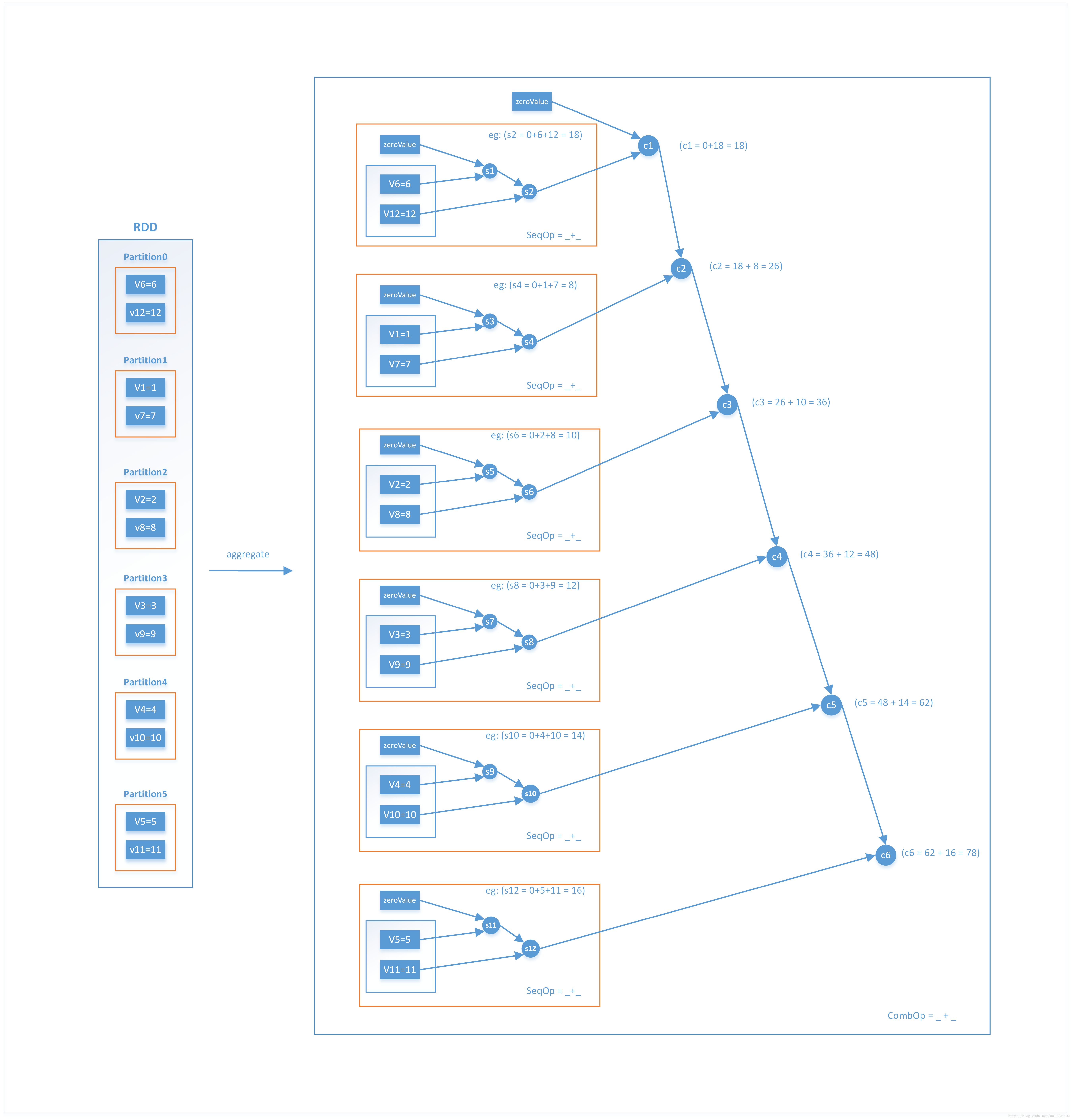
aggregate函数将每个分区进行seqOp,且从zeroValue开始遍历分区里的所有元素。然后用combOp。从zeroValue开始遍历所有分区的结果。

注:每个partition的seqOp只应用一次zeroValue,最后的combOp也应用一次zeroValue。

用一张图来说明上面的计算过程:

aggregate

3. treeAggregate

1
2
3
4
def treeAggregate[U: ClassTag](zeroValue: U)(
seqOp: (U, T) => U,
combOp: (U, U) => U,
depth: Int = 2): U1234

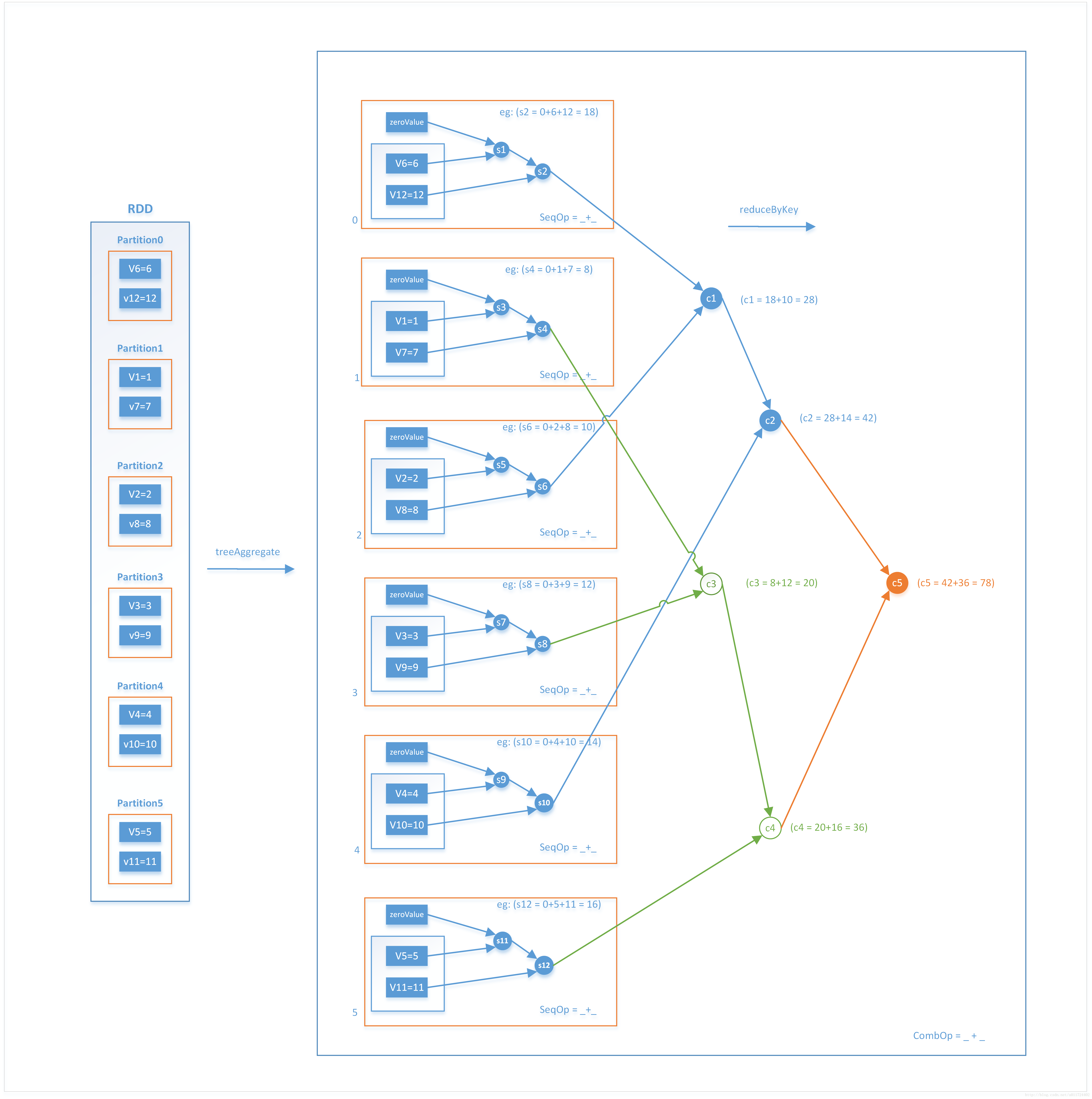
与aggregate不同的是treeAggregate多了depth的参数,其他参数含义相同。aggregate在执行完SeqOp后会将计算结果拿到driver端使用CombOp遍历一次SeqOp计算的结果,最终得到聚合结果。而treeAggregate不会一次就Comb得到最终结果,SeqOp得到的结果也许很大,直接拉到driver可能会OutOfMemory,因此它会先把分区的结果做局部聚合(reduceByKey),如果分区数过多时会做分区合并,之后再把结果拿到driver端做reduce。

注:与aggregate不同的地方是:在每个分区,会做两次或者多次combOp,避免将所有局部的值传给driver端。另外,初始值zeroValue不会参与combOp。

具体可以参见源码:

1
2
3
4
5
6
7
8
9
10
11
12
13
14
15
16
17
18
19
20
21
22
23
24
25
26
27
28
29
30
31
32
33
34
35
/**
* Aggregates the elements of this RDD in a multi-level tree pattern.
*
* @param depth suggested depth of the tree (default: 2)
* @see [[org.apache.spark.rdd.RDD#aggregate]]
*/
def treeAggregate[U: ClassTag](zeroValue: U)(
seqOp: (U, T) => U,
combOp: (U, U) => U,
depth: Int = 2): U = withScope {
require(depth >= 1, s"Depth must be greater than or equal to 1 but got $depth.")
if (partitions.length == 0) {
Utils.clone(zeroValue, context.env.closureSerializer.newInstance())
} else {
val cleanSeqOp = context.clean(seqOp)
val cleanCombOp = context.clean(combOp)
val aggregatePartition =
(it: Iterator[T]) => it.aggregate(zeroValue)(cleanSeqOp, cleanCombOp)
var partiallyAggregated = mapPartitions(it => Iterator(aggregatePartition(it)))
var numPartitions = partiallyAggregated.partitions.length
val scale = math.max(math.ceil(math.pow(numPartitions, 1.0 / depth)).toInt, 2)
// If creating an extra level doesn't help reduce
// the wall-clock time, we stop tree aggregation.

// Don't trigger TreeAggregation when it doesn't save wall-clock time
while (numPartitions > scale + math.ceil(numPartitions.toDouble / scale)) {
numPartitions /= scale
val curNumPartitions = numPartitions
partiallyAggregated = partiallyAggregated.mapPartitionsWithIndex {
(i, iter) => iter.map((i % curNumPartitions, _))
}.reduceByKey(new HashPartitioner(curNumPartitions), cleanCombOp).values
}
partiallyAggregated.reduce(cleanCombOp)
}
}1234567891011121314151617181920212223242526272829303132333435
还是用一张图来说明:
treeAggregate

参考:

https://www.cnblogs.com/drawwindows/p/5762392.html

http://blog.csdn.net/lookqlp/article/details/52121057

https://www.jianshu.com/p/27222830d21a